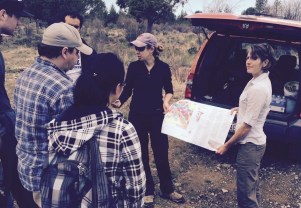
Big Bear Valley, May 2015
Teaching has greatly enhanced my own research and scientific discovery. I have taught courses in earth and environmental science over the past 15 years at multiple levels, including high school and college. My Summary of Teaching Effectiveness includes evaluation averages from all courses I taught at UCLA, selected student comments, and example syllabi. I also included qualitative comments from the Sequoia Field Institute, where I provided interpretive programs to ~4000 visitors at Sequoia National Park in 2017.
I enjoy curriculum development, and have designed inquiry-based exercises and modules for both high school and college. From 2013-2015, I was involved with UCLA’s Undergraduate Education Initiative cluster program. The Global Environment was a team-taught, interdisciplinary course spanning the year, culminating in a spring seminar I designed called Fueling the Future. We examined the environmental and economic impacts of all major conventional and renewable energy resources. I’m frequently asked for materials from this course, and editable versions are available here as a .zip file. Other favorite classes include Women and Climate Change for the U Maine Women, Gender and Sexual Studies Program (with a fantastic public speaking series) and Paleoecology and Landscape History for Lehigh University. Our semester of remote learning culminated in an in-person field trip to Devonian and Quaternary sites in Pennsylvania and New York. We saw some of the oldest fossil evidence for trees and fire in North America! See our class blog “Landscape History of the Allegheny Plateau.”
Next Generation Science Standards (NGSS) offers a great deal of rigor and flexibility to earth science education. NGSS has been developed since I left high school teaching, and I’m excited about the possibilities. In 2017, I developed a teaching unit on California climate and vegetation change over long timescales, aligned to NGSS. I saw a way to incorporate several interests and gaps in ecology/biogeography pedagogy. The unit uses two platforms I frequently use in research, CalFlora and Neotoma Explorer. The California Geographical Society, one of my favorite professional societies, supported its publication and dissemination. A short paper about it is available via The California Geographer. The unit is hosted at Carleton College’s Science Education Resource Center.
 Katherine C. Glover, Ph.D.